
What if the safest professional decision about a restrictive practice isn’t “yes” or “no” — but “not yet”?
For implementing providers, the NDIS framework sets out what must happen when a restrictive practice is unauthorised: it must be reported, and defined steps must be taken while authorisation is pursued.
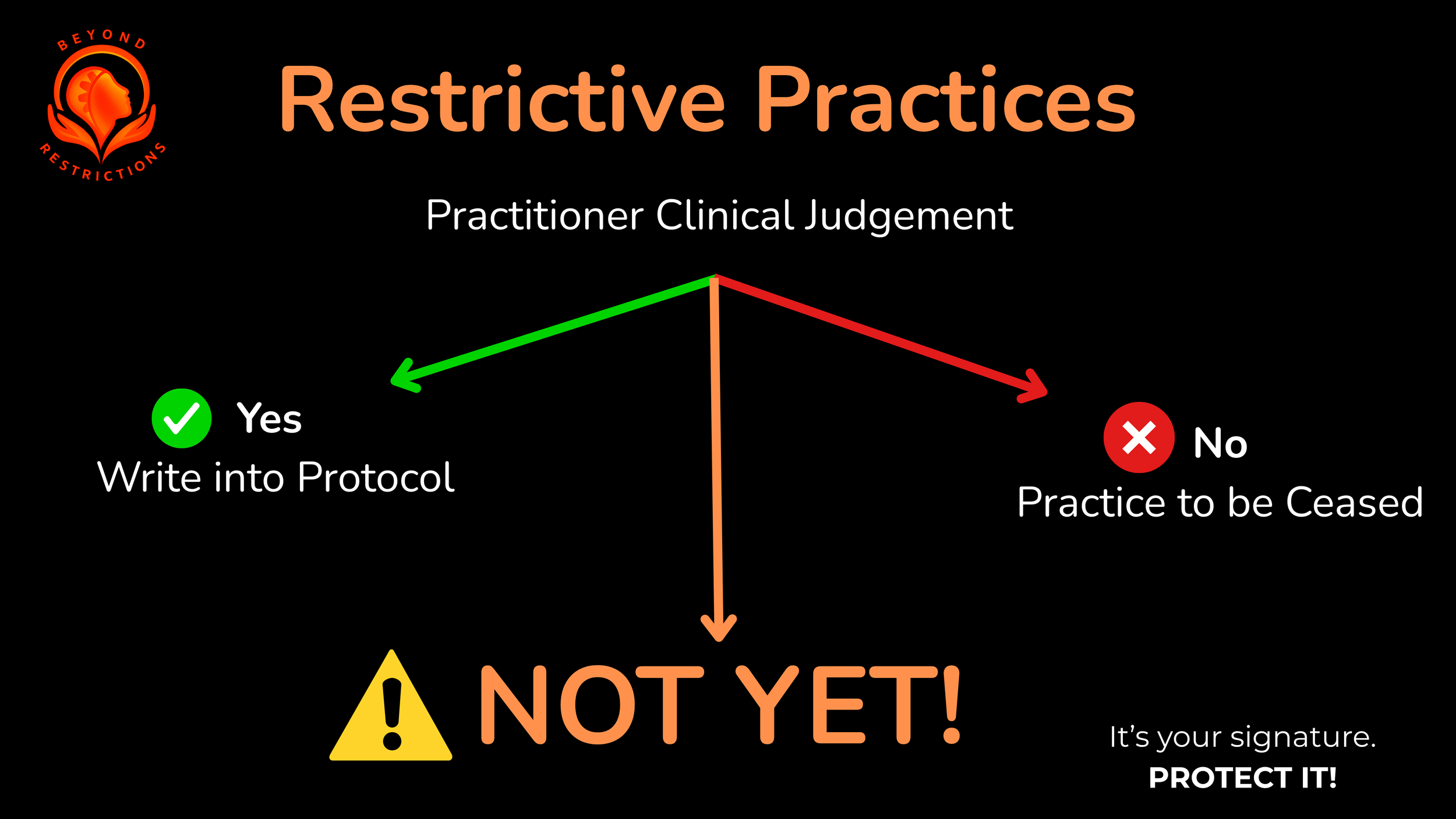
For practitioners, however, there is no clearly defined equivalent. Within strict legislative timeframes for completing a Behaviour Support Plan, practitioners are expected to make one of two professional decisions:
🟢 Yes — document the restrictive practice within a protocol, recording the practitioner’s professional decision that, based on the available evidence, its use meets the relevant legislative requirements.
🔴 No — document the restrictive practice as a practice to be ceased, recording the practitioner’s professional decision that the available evidence supports its safe cessation.
What happens when a Behaviour Support Plan is due and the practitioner does not yet have the documentation or evidence needed to determine whether the practice is necessary, proportionate, the least restrictive option and the safest response for the participant?
For more than 12 months, we have explored this dilemma by asking questions, testing case examples and listening to practitioners across Australia. That work led us to develop a clearer way for practitioners to communicate their professional decision-making when essential documentation or evidence is not yet available.
In August 2026, at the ACRRE Emerging Leaders Program, facilitated by Sharon Paley and Dr Fiona Davies, Beyond Restrictions shared how Beyond Restrictions communicates this professional decision in practice:
🟠 Not yet.
“Not yet” is not a new authorisation category. It does not authorise the continued use of a restrictive practice, replace reporting obligations or delay the safeguards a participant needs. It allows the practitioner to clearly document their professional decision within the restrictive practice protocol: based on the information currently available, they cannot yet determine that the restrictive practice meets the relevant legislative requirements. The protocol, including the practitioner’s clinical judgement, is then uploaded to PRODA in accordance with NDIS requirements.
During the presentation, the Emerging Leaders took part in a game of “yes or no,” using red and green cards to vote on case examples where essential documentation was unavailable. The room divided. The case was the same. The information was the same. The professional decisions were not.
The discussion then turned to the real-world consequences of those decisions. Restrictive practices affect a person’s rights, dignity and safety. Behaviour Support Plans, clinical decisions and practitioner signatures can — and do — end up being examined line by line in coroners’ reports.
The discussion reiterated an important message for every practitioner: it is your signature on the plan. Your signature is not an administrative step. It records a professional decision that you must be prepared to explain, justify and stand behind. Protecting your signature means recognising that decisions affecting a participant’s rights and safety require the information needed to make them responsibly.
At Beyond Restrictions, the “not yet” framework has changed the conversations we have with providers and specialist panel representatives. Since putting it into practice, we have learned that we did not need to chase harder for evidence. We needed to communicate more clearly about what was missing, why it mattered and what needed to happen next. That clarity gave everyone involved a pathway forward — and a clearer understanding of their role in improving the participant’s safety.
The “not yet” framework is relevant in every Australian state and territory because it does not depend on a particular legislative framework or authorisation process. Across every jurisdiction, the same professional question applies: do I have the information needed to make this decision safely, defensibly and in the participant’s best interests? If not, the answer may not be “yes” or “no.”
It may be “not yet.”
The plan may be due. That does not mean the evidence is available yet. The most dangerous professional decision is the one made before you had the information needed to make it safely.
We are passionate about this conversation and would love to hear from you. Whether you support the “not yet” framework, have questions, or are unsure how it could apply within your practice — let’s talk!